
🎯Quick Answer: Air Duct vs Air Connector
UL 181 contains seventeen tests. A listed air duct passes all seventeen. A listed air connector is never given three of them — flame penetration, puncture and impact. Because of those three gaps, the codes cap an air connector at 14 feet (IMC 603.6.2.1) and forbid it from passing through any wall, floor or ceiling (IMC 603.6.2.2), while a listed air duct has no code length limit (IMC 603.6.1.1). Both can be Class 1, because Class describes fire performance, not category. Tell them apart in five seconds: an air duct carries a rectangular label reading "Listed Air Duct." An air connector carries a round label reading "Listed Air Connector — for installation in lengths not over 14 feet."
We make flexible duct for a living, and the question that lands in our inbox more than any other is some version of this: "Your competitor quoted me UL 181 Class 1 at half your price. Same thing, right?"
Sometimes it is. Often it is not, and the buyer has no way to tell from the quote, because both products are honestly and accurately described as "UL 181 Class 1." That phrase is true of a product that can run the length of a building, and equally true of a product that becomes a code violation at 14 feet and 1 inch.
This guide is the version of that conversation we have on the phone, written down: what the two listings actually are, which tests separate them, why the length rule is a consequence rather than an arbitrary number, the price gap that drives substitution, and the three questions that settle it before you release a purchase order.
Two Listings Hiding Behind One Phrase
UL 181, Standard for Safety, Factory-Made Air Ducts and Air Connectors, does exactly what its title says: it covers two different products. The industry shorthand "UL 181 flex" collapses them into one, which is where the trouble starts.
The North Carolina Office of the State Fire Marshal put the problem on paper in a formal code interpretation back in 2011, and the wording has aged well: flexible air ducts and flexible air connectors "are similar in appearance causing confusion of their identification and sometimes resulting in improper use."
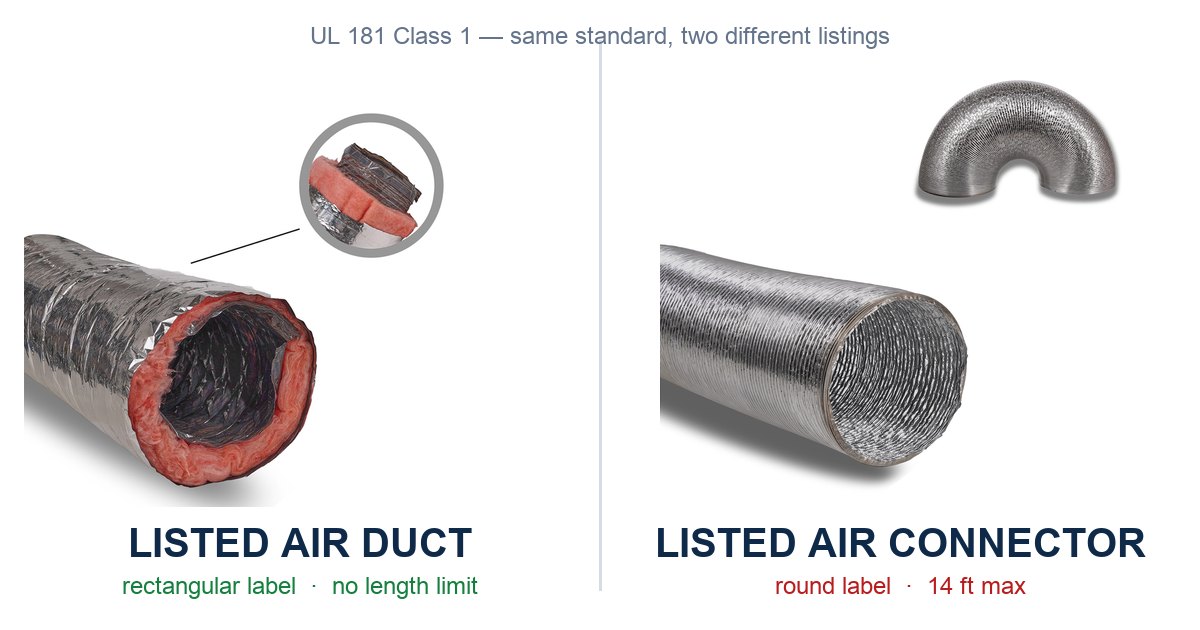
| Listed Air Duct | Listed Air Connector | |
|---|---|---|
| UL 181 tests passed | All 17 | 14 of 17 |
| Tests not performed | None | Flame penetration, puncture, impact |
| Label shape | Square or rectangular | Round |
| Label wording | "Listed Air Duct" | "Listed Air Connector" + "for installation in lengths not over 14 feet" |
| Installed length limit | None (IMC 603.6.1.1) | 14 ft (IMC 603.6.2.1) |
| Through wall / floor / ceiling | Permitted (non-rated) | Prohibited (IMC 603.6.2.2) |
| Through fire-rated assembly | Prohibited (IBC 717.7) | Prohibited (IBC 717.7) |
| Fire class available | Class 0 or Class 1 | Class 0 or Class 1 |
| Typical construction sold in US | Insulated, R4.2 / R6 / R8 | Non-insulated aluminum or foil |
| Intended job | Conveying air: trunk to register, full branch runs | Connecting components: equipment to ductwork, absorbing vibration and misalignment |
Read the last row again, because it is the design intent everything else follows from. A connector was never meant to be the duct. It was meant to be the short, accessible, visible piece that joins a machine to a duct system and takes up the vibration and the quarter-inch of misalignment nobody drew. Every restriction on it is downstream of that job.
Reading the Label in Five Seconds
You do not need a certification directory on the job site. You need to find the printed listing mark on the outer jacket and answer two questions.
| What you see | What it is | What you may do with it |
|---|---|---|
| Rectangular mark, "Listed Air Duct," no length text | Air duct | Any length; may pass through non-rated walls, floors, ceilings |
| Round mark, "Listed Air Connector," "lengths not over 14 feet" | Air connector | 14 ft max; accessible spaces only; crosses nothing |
| Printed "UL 181 compliant" / "meets UL 181," no mark | Not a listing | Nothing, until the supplier produces a file number |
| Mark says UL 2158A, "transition duct" | Clothes dryer transition duct | 8 ft max, dryer to wall outlet only, never HVAC supply |
⚠️The five-second field check
Round label means count the feet. Rectangular label means you are free on length but still bound by every other rule — support spacing, bend radius, and the fire-rated assembly prohibition in IBC 717.7. If there is no listing mark at all on the jacket, the product has no listing, whatever the carton says.
That fourth row catches people every season. A UL 2158A dryer transition duct is a third category with its own standard, evaluated against only eight of the UL 181 tests and capped at 8 feet of produced and installed length. It exists to connect a dryer to the stationary wall outlet. It is not duct. Our rigid vs flexible dryer duct guide covers that separate rulebook.
The Three Tests a Connector Never Takes
Here is the part almost nobody publishes, and it is the part that makes the length rule make sense. UL 181 is seventeen tests. Below is the full list, with the exact conditions, and with the three an air connector is simply not given.
| UL 181 test | What it does | Air duct | Air connector |
|---|---|---|---|
| Surface burning | Steiner tunnel per UL 723 / ASTM E84, 25 ft flattened sample, 10 min, inner and outer surface | Yes | Yes |
| Flame penetration | 2 ft x 2 ft wall section over a 1625°F furnace, 8 lb weight on a 1 in x 4 in bearing surface, 30 min without collapse or penetration | Yes | Not tested |
| Small-scale burning | 2-1/2 in propane flame, 60 s exposure, horizontal / 45° / vertical, must self-extinguish within 60 s | Yes | Yes |
| Flame resistance | Fabrics, tapes and joining materials exposed to the internal air stream | Yes | Yes |
| Mold growth & humidity | Inoculated samples, saturated dark vessel, not less than 60 days | Yes | Yes |
| Corrosion | Steel coated to 0.3 oz/sq ft zinc equivalent, ASTM B117 salt spray fog | Yes | Yes |
| Temperature aging | 48 h saturated, then 0°F for 24 h; plus 265°F inside / 125°F outside simultaneously for 60 days | Yes | Yes |
| Positive pressure | 2-1/2 x rated positive pressure, 8 ft sample, 1 h, no rupture | Yes | Yes |
| Collapse (negative pressure) | 2-1/2 x rated negative pressure, 1 h, cross-section loss not over 20% | Yes | Yes |
| Leakage | Not over 20 x sample volume at 0.50 in. w.c. held 1 h | Yes | Yes |
| Tension | 25 lb vertical load on an 8 ft sample for 24 h | Yes | Yes |
| Torsion | 25 ft-lb or 180° rotation, whichever first, 5 cycles each direction | Yes | Yes |
| Bending | 180° arc over a mandrel equal to one duct diameter, 5 cycles | Yes | Yes |
| Impact | 15 lb formed sand bag dropped from 10 in; average deformation not over 20% of cross-section, no single sample over 25% | Yes | Not tested |
| Static load | 2-1/2 x the weight of an 8 ft sample, applied uniformly for 24 h (products with integral field support) | Yes | Yes |
| Puncture | 2 lb plunger, 3/8 in steel rod with 9/16 in impact head, free fall from 20 in at three points 120° apart | Yes | Not tested |
| Erosion | 2-1/2 x rated velocity or 2500 FPM, whichever is lower, through a 1-diameter 90° bend, 4 h particle collection | Yes | Yes |
Look at what the three missing tests have in common. Flame penetration is fire from outside the duct. Puncture is a screw, a nail gun, a drill bit. Impact is a knee, a boot, a dropped tool. All three are about what happens to the product once it is buried in a building where nobody can see it and nobody will ever inspect it again.
🎯The insight the length rule is built on
The 14-foot limit is not a statement about length. It is a statement about exposure. A product that was never tested for fire from outside, for puncture, or for impact is restricted to short, accessible, visible runs — precisely the places where those three failure modes are least likely and most repairable. Once you see it that way, the companion rule stops being surprising: a connector cannot pass through a wall, floor or ceiling at any length at all, because concealment, not distance, is the actual hazard.
This also explains a question we get from value engineers: "can I just use two connectors to cover 24 feet?" No. Splicing two 14-foot connectors does not create a 28-foot air duct any more than stapling two learner permits makes a driver's license. The listing applies to the product, and the installed run is still connector.
💡Not sure which listing your drawing requires?
Send us the run list — length, what each run passes through, and the space it sits in — and we will mark which runs can take a listed connector and which need listed air duct, before you price anything. Ask an engineer or see the flexible duct range.
What 14 Feet Actually Buys You
Here is the arithmetic that changes how people specify. Fourteen feet sounds generous for a branch. In airflow terms it is not, because the 14 feet you are allowed is measured with a tape, while the resistance the fan sees is measured in total equivalent length — and fittings dominate that number.
The Air Diffusion Council's worked example, using ACCA Manual D equivalent lengths, runs like this for a single flexible branch:
| Element in the run | Count | Equivalent length |
|---|---|---|
| Entrance fitting (takeoff) | 1 | 35 ft |
| Actual duct length (tape measure) | — | 14 ft |
| 45° bends | 2 | 20 ft |
| 90° bend | 1 | 20 ft |
| Exit fitting (boot / register) | 1 | 35 ft |
| Total equivalent length | — | 124 ft |
Fourteen feet of duct, 124 feet of equivalent length. The physical duct is 11 percent of the resistance. The fittings are the other 89 percent.
That ratio is the practical lesson, and it cuts both ways. If you are arguing that a connector's 14-foot cap is too restrictive, the cap is rarely your real constraint — the takeoff, the bends and the boot already spent most of your pressure budget before the cap became relevant. And if you are pleased that a listed air duct has no code length limit, notice that "no code limit" and "no consequence" are different statements. Add one more 90° bend to that run and you have added 20 feet of equivalent length without moving the register an inch.
⚠️The compression multiplier on top of all this
Every equivalent-length figure above assumes the flex is pulled taut. Flexible duct installed with the core left slack has dramatically higher friction than the same duct fully stretched, which is why the Air Diffusion Council's installation standard is built around stretching runs and supporting them properly. A 14-foot connector installed at 12 feet of span with 2 feet of slack is not a 14-foot run in any sense the fan cares about. Our flex duct installation guide covers stretch, support spacing and bend radius in detail.
Where Code Says a Connector Cannot Go
Section 603.6 of the International Mechanical Code splits the rules cleanly. Both categories must be tested to UL 181 and listed and labeled as Class 0 or Class 1. After that the paths diverge.
| Section | Applies to | Requirement |
|---|---|---|
| IMC 603.6.1 | Flexible air ducts | Tested to UL 181, listed and labeled Class 0 or Class 1 |
| IMC 603.6.1.1 | Flexible air ducts | Shall not be limited in length |
| IMC 603.6.2 | Flexible air connectors | Tested to UL 181, listed and labeled Class 0 or Class 1 |
| IMC 603.6.2.1 | Flexible air connectors | Limited in length to 14 ft (4267 mm) |
| IMC 603.6.2.2 | Flexible air connectors | Shall not pass through any wall, floor or ceiling |
| IMC 603.6.3 | Both | Design temperature of conveyed air less than 250°F (121°C) |
| IBC 717.7 | Both | Shall not pass through any fire-resistance-rated assembly |
Translated into the decisions a designer actually makes:
| The run | Connector OK? | Why |
|---|---|---|
| Air handler to plenum, 3 ft, mechanical room | Yes | Short, accessible, crosses nothing — the job it was designed for |
| Trunk to ceiling register, 9 ft, open attic | Yes | Under 14 ft, no penetration; boot is the ceiling element, not the flex |
| Trunk to register, 3 ft, but crosses a stud wall | No | IMC 603.6.2.2 — length is irrelevant once it passes through a wall |
| Branch run, 18 ft, open attic | No | Over 14 ft — needs listed air duct |
| Between floors through a joist bay | No | Passes through a floor |
| Through a 1-hour rated corridor wall | No — and neither is air duct | IBC 717.7; this is rigid duct and damper territory |
| Range hood or dryer exhaust | No — neither category | Separate code sections require rigid or semi-rigid metal |
Rows three and four are worth separating in your head, because they fail for different reasons and the fix is different. Row four is a length problem, solved by buying the right product. Row three is a topology problem: no length of connector fixes it. We see rejected inspections on row three far more often than row four, because the crew measured carefully and never asked what the flex was passing through.
For the runs that do need rigid, our flex duct vs metal duct comparison covers where each belongs, and the range hood duct guide covers the kitchen exhaust rules specifically.
Class 0, Class 1, and "UL 181 Compliant"
Class and category are independent axes, and conflating them is how a spec ends up specifying nothing useful.
| Phrase on the quote | What it actually tells you | What it does not tell you |
|---|---|---|
| "Class 0" | Flame spread index 0 and smoke developed index 0 per UL 723 / ASTM E84 | Whether it is duct or connector |
| "Class 1" | Flame spread index 25 or less, smoke developed index 50 or less | Whether it is duct or connector |
| "UL 181 listed" | A certification body tested it and audits the factory; a file number exists | Class, and duct vs connector |
| "UL 181 compliant / meets / tested to" | Nothing enforceable — no file, no follow-up inspection | Everything |
| "UL 181 Class 1 Listed Air Duct, file #____" | Class, category and traceability — a complete specification | — |
One more distinction that gets folded into the same conversation: UL 181A and UL 181B are not duct standards at all. They cover closure systems — the tapes, mastics and mechanical fasteners used at joints. 181A-P, 181A-M and 181A-H are for rigid fiberglass duct board; 181B-FX and 181B-M are for flexible duct. A listed air duct joined with hardware-store cloth tape is still a failed installation. The duct sealing guide and the ducting accessories guide cover the closure side.
The Price Gap That Drives Substitution
Nobody substitutes a connector for a duct out of malice. They do it because the gap is large and the products look identical on a pallet. These are our factory-direct ranges out of Brookshire, Texas, per linear foot, at contractor volume.
| Diameter | Non-insulated (typically connector) | R6 insulated (typically air duct) | Gap |
|---|---|---|---|
| 4 in | $0.48 – $0.72 | $1.20 – $1.70 | ~2.4x |
| 6 in | $0.64 – $0.96 | $1.40 – $2.00 | ~2.2x |
| 8 in | $0.88 – $1.28 | $1.85 – $2.60 | ~2.1x |
| 10 in | $1.12 – $1.60 | $2.30 – $3.20 | ~2.0x |
| 12 in | $1.40 – $2.00 | $2.80 – $3.90 | ~2.0x |
Roughly two to two-and-a-half times, and on a 200-run tract job that is real money. Which is exactly why we want the next paragraph in writing.
🎯The recommendation that costs us margin
If a run is under 14 feet, sits in an accessible space, and passes through nothing, buy the connector. It is code-compliant, it is the product the standard intended for that job, and specifying listed air duct there is paying roughly double for a flame penetration test that installation will never call on. We would rather quote you the cheaper product on 60 runs and the correct product on the 12 that need it than sell you one line item for all 72. The expensive mistake is never "bought a connector" or "bought a duct." It is buying one category for the whole job and discovering at rough-in inspection that a dozen runs were in the other one.
For volume tiers, freight and pallet economics across both categories, see the wholesale flexible duct pricing guide and the contractor bulk ordering guide.
Insulated Does Not Mean Air Duct
The shortcut everyone uses — silver and fluffy is duct, silver and bare is connector — is a reliable heuristic and a terrible rule. The Air Diffusion Council states the principle directly: the category is determined by how the product performed when tested to UL 181, not by its construction, type, or whether it is insulated.
In practice, insulated air connectors do circulate (they are more common in the Canadian market), and non-insulated air ducts are sold in both the US and Canada. Two ways this bites:
- An installer assumes the insulated product on the truck is an air duct, runs 20 feet of it, and it turns out to be an insulated connector. Passes the eye test, fails the label test.
- A specifier writes "non-insulated flex, 20 ft run" assuming non-insulated is automatically disqualified on length, when a listed non-insulated air duct would have been perfectly legal. That one costs money rather than compliance.
Insulation is an R-value decision, driven by where the run sits — unconditioned attic, crawl space, conditioned chase. That is a completely separate axis from the listing category, and we cover it in the R4 vs R6 vs R8 comparison, the attic duct insulation guide and the non-insulated flexible duct guide. Decide R-value and category independently, then buy the product that satisfies both.
How to Verify a Listing Before the PO
Four steps, about ten minutes, and they work on any supplier including us.
- Ask which category, in writing. "Is this listed as an Air Duct or an Air Connector?" A real manufacturer answers in one word. Hesitation, or an answer that repeats "UL 181 Class 1" back at you, is the answer.
- Ask for the certification body and file number. UL Solutions, Intertek/ETL and similar bodies all publish searchable online directories. A listing you cannot find in a directory is not a listing.
- Ask for a photograph of the printed label on production stock — not the catalog page, not the certificate PDF. You are checking the shape and the wording: rectangular "Listed Air Duct," or round "Listed Air Connector … lengths not over 14 feet."
- Ask for the manufacturer's installation instructions. The NC state fire marshal's interpretation points here specifically: the full limitations of use live in the manufacturer's instructions, which normally incorporate the Air Diffusion Council's Flexible Duct Performance and Installation Standards. If a supplier has no installation instructions, they are not the manufacturer.
ℹ️Where we sit, stated plainly
We manufacture and stock flexible duct and industrial hose at a 46,000 sq ft facility in Brookshire, Texas, and we will tell you the listing category of any item before you order — including the items where the honest answer is "that one is a connector, keep it under 14 feet." We would rather lose a line item than have a customer fail a rough-in. If a listing category matters to your project, ask us for it on the quote and we will put it in writing next to the part number.
Spec Language You Can Copy
Most flexible duct specifications we receive say some version of "flexible duct shall be UL 181 Class 1." As shown above, that sentence permits a product capped at 14 feet on a 25-foot run. Here is language that closes it:
💡Suggested specification text
"Flexible duct for branch runs shall be factory-made flexible air duct, tested in accordance with UL 181 and listed and labeled as Class 1 Air Duct (rectangular listing mark). Flexible air connectors are permitted only for equipment connections, shall not exceed 14 feet installed length, and shall not pass through any wall, floor or ceiling. Submit certification body, file or listing report number, and a photograph of the production listing label for each item. Closures shall be UL 181B-FX or UL 181B-M listed. Installation shall comply with the manufacturer's instructions and the Air Diffusion Council Flexible Duct Performance and Installation Standards."
Three sentences, and it removes every ambiguity discussed on this page: category, length, penetration, traceability, closures and workmanship. Paste it into your next mechanical spec.
Frequently Asked Questions
Frequently Asked Questions
What is the difference between a UL 181 air duct and an air connector?
Does UL 181 Class 1 mean it is an air duct?
How long can flexible duct be?
Which three UL 181 tests does an air connector skip?
Can I use flexible air connector through a wall or ceiling?
Is insulated flex duct always an air duct?
What does "UL 181 compliant" mean on a supplier datasheet?
Is it worth paying more for air duct where a connector is legal?
Sources
- Air Diffusion Council, Characteristics, Testing & Classification of Flexible Air Ducts & Air Connectors, presented to ASHRAE TC 5.2, Summer Meeting 2014 — seventeen-test list, test parameters, category definitions, label shapes, equivalent-length example.
- International Mechanical Code, Section 603.6 (603.6.1, 603.6.1.1, 603.6.2, 603.6.2.1, 603.6.2.2, 603.6.3).
- International Building Code, Section 717.7, Flexible ducts and air connectors.
- NC Department of Insurance, Office of the State Fire Marshal, Engineering Division, code interpretation 0603.6, Clarification of Flexible Air Duct and Flexible Air Connector, September 1, 2011.
- UL 723 / ASTM E84, Surface Burning Characteristics of Building Materials; UL 2158A, Clothes Dryer Transition Duct.
- ACCA Manual D equivalent lengths as cited in the ADC presentation above.
Related Guides
- Flex Duct vs Metal Duct: Cost, Airflow & Code Comparison
- Flex Duct Installation Guide: Stretch, Support & Bend Radius
- Duct Sealing Guide: UL 181A / 181B Closures, Tape vs Mastic
- R4 vs R6 vs R8 Duct Insulation: Which R-Value Do You Need?
- Non-Insulated Flexible Duct: Specs, Sizes & Applications
- Flex Duct Sizes Guide: Diameters, CFM & Selection
- Flexible Ducts: Aluminum, Polyester & PVC
- Insulated Ducts: R4.2, R6 and R8
Request a Quote for UL 181 listed flexible air duct and air connectors
Fill in your requirements. We respond within 24 hours on business days.